

VoIP Network Services
Networks connect the world and bring people closer together. Networks are complex and intricate structures.
We plan, optimize, and test your network infrastructure to ensure stable and trouble-free VoIP communication. This ensures that voice quality and availability remain reliable even under complex conditions.

Networks in Telecommunications
For VoIP or Teams calling, networks must function properly
Many system administrators have already encountered network infrastructure challenges when implementing VoIP. A delay of a few seconds—or even milliseconds—in an email or chat message often goes unnoticed. In a phone call, however, this is completely unacceptable.
Network disruptions and bottlenecks can have a variety of causes. These range from faulty or outdated cables and low-quality connectors to interference from neighboring cables. Identifying network performance issues can prove to be an extremely tricky challenge.
In certain cases, it is advisable to conduct a comprehensive network assessment rather than searching for errors after the fact. After all, operations should be disrupted as little as possible. When connecting multiple locations, an additional dimension of uncontrollable connections comes into play, which requires careful planning and implementation. Depending on their importance, redundant Internet connections should be provided, and these should use different media. It’s of no use if an excavator cuts the cable in front of the building and both Internet service providers use the same type of connection.
How is the quality of a phone call measured?
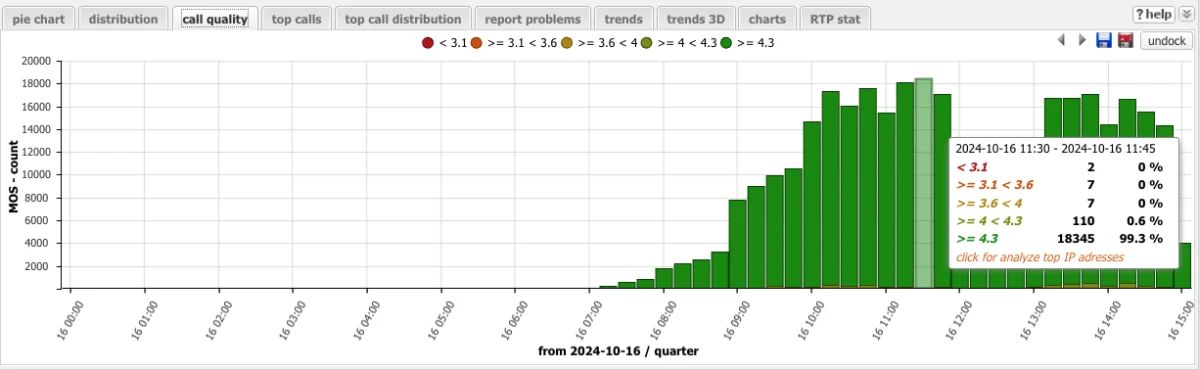
The quality of VoIP calls is defined by what is known as the MOS score. The MOS score is calculated based on jitter, latency, and packet loss, and can reach a maximum value of 4.5. Theoretically, a score of 5 is achievable, but it is not possible due to normal latency.
In a LAN, the values should always be greater than 4.3, since we can control and influence the environment here. In a WAN, however, factors such as poor reception on the mobile data channel or a poor Internet connection can result in lower values. Values below three are already clearly audible and disruptive.
SBC for SIP and Microsoft Teams
What is a session border controller?
A Session Border Controller, or SBC for short, is a specialized device that protects and controls IP communication flows. As the term suggests, Session Border Controllers are used at the boundaries of networks to monitor IP communication sessions. Originally developed to secure and regulate VoIP networks, SBCs are now used in all forms of real-time communication, including VoIP, IP video, text chat, and collaboration sessions.
Winet has developed its own session border controllers based on Kamailio. Kamailio® is an open-source SIP server released under the GPLv2+ license that can process thousands of call settings per second. Kamailio can be used to build large-scale platforms for VoIP and real-time communication—including presence, WebRTC, instant messaging, and other applications.
Powerful features include: asynchronous TCP, UDP, and SCTP; secure communication via TLS for VoIP (voice, video, text); WebSocket support for WebRTC; IPv4 and IPv6; SIMPLE instant messaging and presence with an embedded XCAP server and MSRP relay; asynchronous operations; IMS extensions for VoLTE; EN UM; DID and least-cost routing; load balancing; routing failover; billing, authentication, and authorization; support for many backend systems such as MySQL, Postgres, Oracle, RADIUS, LDAP, Redis, Cassandra, MongoDB, and Memcached; JSON and XML-RPC control interfaces; SNMP monitoring.
SBC for SIP
Winet's SIP SBC manages all calls and connections that run through Ayrix or other hosted PBX systems. It is also responsible for connections to other carriers.
We use the SBC as a session controller and load balancer for the voice switches. Its reliability is unmatched, and—along with the databases—it forms the core of our carrier backbone.
SBC for MS Teams
This SBC was also built on the Kamalio platform. However, it uses Microsoft’s proprietary Direct Routing protocol. Direct Routing is also RFC-compliant, but at the other end of the chain, and is therefore not readily compatible with SIP. Winet customers benefit from a carrier-grade SBC that does not require expensive licensing fees. Once again, Winet has come up with something innovative for its customers.