









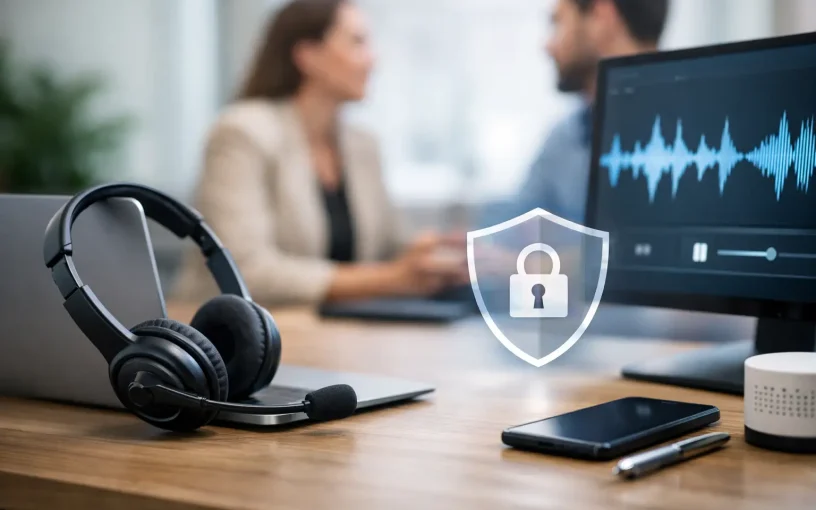
A recorded support request can help resolve an issue, secure an order, or provide targeted training for employees. However, it also contains voices, statements about individuals, and often sensitive business information. Anyone who Set Up Call Recording in Compliance with Data Protection Regulations Therefore, if you want to do this, you need more than just an activated record button on the phone system: You need a clear purpose, a well-defined process, and technical controls that work in day-to-day operations.
For Swiss companies, a simple rule applies: Not everything that is technically possible is also permissible or advisable. Especially for incoming customer calls, HR interviews, consulting sessions, or calls made via Microsoft Teams, the recording must be authorized before the first word is recorded.
Purpose First, Technique Second
The most common vulnerability does not lie in the SIP trunk, the cloud PBX, or the storage location. It lies in the lack of a specific purpose. «For security» or «for better quality» is too vague as an internal justification. Specify exactly which calls are being recorded, why this is necessary, and who derives what business benefit from it.
Typical uses include documenting binding telephone orders, ensuring quality in customer service, maintaining a record of consultations, or training new employees. For each of these cases, you should determine whether a recording is truly necessary. When scheduling an appointment or simply transferring a call, a call log or an entry in the CRM is usually sufficient. Less data means less risk and less effort when handling requests for access or deletion.
In addition, distinguish between call recordings and connection data. A phone number, the time, duration, and routing of a call are not the same as an audio file containing the content of the conversation. Both types of data deserve protection, but call recordings are significantly more intrusive and require stricter regulation.
Clarify the legal basis for admission
In Switzerland, the revised Data Protection Act and the protection of privacy are particularly relevant. In addition, criminal law may apply to private conversations. Secret recording is therefore not an option. All participants in a conversation must be clearly informed before the recording begins and must consent to the recording.
If your company works with individuals in the EU or directs an offer to them, the GDPR may also apply. In that case, the processing must also have a sound legal basis under European law. Consent is not the only possible legal basis in every situation. However, for the specific purpose of initiating contact, clear, verifiable consent is often the most transparent and lowest-risk approach.
Special caution is required when dealing with employees. In employment relationships, consent is not always freely given due to the dependent nature of the relationship. Ongoing monitoring of performance or conduct through recorded conversations is a sensitive issue. Establish strict guidelines for quality control, provide transparent information, and consult with HR, data protection officers, or legal counsel as needed.
This article is not a substitute for a legal review of individual cases. However, it illustrates which organizational and technical decisions support compliance with data protection regulations.
Design consent so that it works in practice
A brief IVR announcement before the call is connected is often the best way to start incoming calls. It should clearly state that the call is being recorded, explain the purpose of the recording, and tell callers how they can opt out or proceed without the call being recorded. Timing is crucial: The message must be played before the recording begins, not after the employee has greeted the caller.
A simple announcement alone does not automatically constitute a free pass. When you seek consent to continue the call, the choice must be voluntary and transparent. Offer a genuine alternative, such as transferring the caller to a non-recorded hold queue, a callback, or another contact channel. Anyone who would have to hang up without an alternative effectively has little choice.
For outbound calls, the employee must actively inform the caller at the beginning of the call and wait for consent. Only then may the recording begin. Modern telephone systems can implement this using a function key, a soft key, or rule-based recording. For particularly sensitive situations, a technical lock is recommended: The record button remains disabled until consent has been confirmed.
A binding standard is also needed internally. Employees should not have to decide on the spot how to gather information. A brief conversation guide provides clarity: state the purpose, obtain consent, wait for a response, and then begin recording. If consent is denied, no audio file may be created.
Setting Up Call Recording in Compliance with Data Protection Laws: The Configuration
A good configuration follows the principle of data minimization. Don’t record every extension, every queue, and every Teams call across the board. Limit recording to clearly defined phone numbers, extensions, or use cases. In a cloud PBX, for example, recording profiles can be assigned to a support queue, while sales, HR, and executive management operate without recording by default.
For the technical implementation, regulations must be established for at least these four areas:
- Recording Logic: Does the recording start automatically, manually, or only after consent has been confirmed? Can employees pause the recording when credit card information, health data, or other particularly sensitive information is discussed?
- Access Rights: Who is allowed to listen to, export, or delete recordings? Role-based permissions, MFA, and centralized user management prevent files from becoming shared resources for teams.
- Location: In which country are audio files, backups, and technical logs stored? Review your order processing agreements, subcontractors, and your cloud provider’s contractual requirements.
- Fire Suppression Plan: How long does a recording remain available, when is it automatically deleted, and how is it removed from backups or made inaccessible?
Encryption during transmission and storage is also standard. In VoIP environments, this applies not only to the audio file. Signaling, media streams, and access to the administration portal must also be protected. SIP TLS and SRTP, properly configured firewalls, and a session border controller can secure the communication path. However, they are no substitute for proper consent and an authorization policy.
At Microsoft Teams It is essential to carefully verify which service triggers the recording and where the data is sent. Teams meetings, PSTN calls, and telephony integrated via a PBX may follow different storage and compliance paths. Native telephony integration simplifies administration, but does not exempt you from verifying the respective recording function.
Define Deletion Deadlines by Business Transaction
«We’ll delete it eventually» is not a data retention policy. Set retention periods based on the specific purpose. A quality check in customer service often takes only a few weeks. Documentation of a contract concluded over the phone may need to be retained for longer, provided this is objectively justified and legally supported. In contrast, blanket retention for years increases costs, exposure, and risk without providing any additional benefit.
Automatic deletion rules are clearly superior to manual reminders. They should also apply to exported files, backups, and transcripts. Transcripts, in particular, are often overlooked: They constitute standalone personal data, are often easier to search than audio files, and may be processed by other service providers as part of AI-based analysis.
You should also document exceptions. If a recording must be retained due to a pending legal case or a complaint, this should be done in a targeted manner and for a limited period of time. Once the reason no longer applies, the regular deletion policy takes effect again.
Ensure Operations, Oversight, and Points of Contact
Data protection doesn’t end once the system goes live. Check at regular intervals to ensure that recording profiles are still correct, that former employees no longer have access, and that deletion jobs are actually running. A quick look at the access logs often reveals more quickly than an audit whether too many people can access recordings.
Establish a clear process for data subjects to request access, correction, and deletion of their data. Anyone who requests a copy of their conversation should not be passed back and forth between support, the relevant department, and IT. Responsibilities, identity verification, and the processing workflow must be defined in advance.
For more complex environments involving multiple locations, CRM integration, IVR, Teams telephony, and external contact center services, it’s worth conducting a joint architecture review. Winet can coordinate the phone system, network security, access permissions, and practical recording logic—with a setup that employees can use and that doesn’t turn into a data protection project every time an adjustment is made.
In the end, the best recording isn't the one with the most minutes stored. It's the one that reliably supports a specific business case, remains transparent to all parties involved, and automatically disappears as soon as it has served its purpose.
Current

Business Internet Planning for Your Company

Teams Integration for Professional Telephony
Why does Microsoft Teams need Direct Routing?

VoIP Provider Reviews for Businesses
Redundant Internet connection or a single connection?