









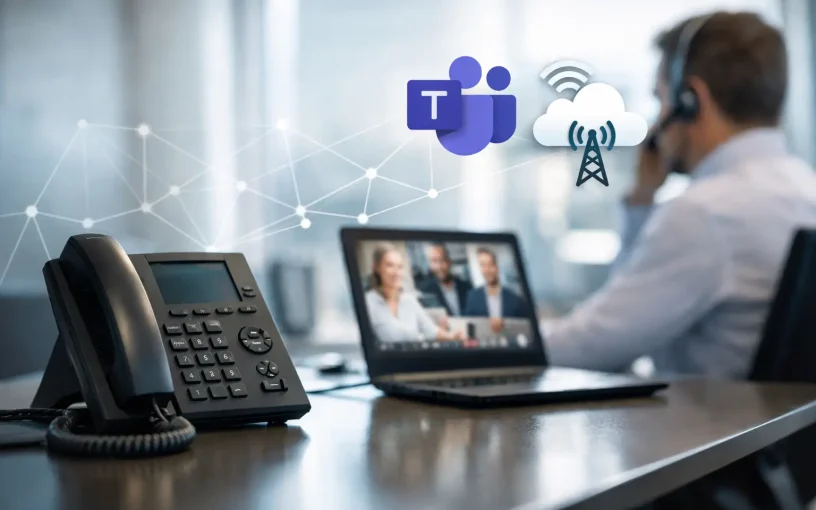
A customer’s call is routed to an employee’s Teams client; if the employee is away, the call is forwarded to the appropriate group and, if necessary, the customer is called back using the existing business number. While this may sound obvious, it is not automatically covered by a collaboration-only license. Why does Teams need Direct Routing? Because that's what turns Microsoft Teams into a full-fledged workplace for external business telephony—with the phone numbers, rules, and integrations that a company actually needs.
For many companies, Microsoft Teams is the central hub for chat, meetings, files, and internal calls. However, calls to landlines and cell phones require a connection to the public switched telephone network. Direct Routing connects Teams via a Session Border Controller (SBC) to a SIP trunk and a telephony platform. This allows the Teams interface to be integrated with professional business communications without hastily abandoning established workflows.
Why Teams Direct Routing Makes Sense for Businesses
The main advantage lies in the freedom of choice. Companies decide for themselves which provider to use for their telephony, which phone numbers to use, and how call routing is organized. This is particularly important when Swiss phone numbers, international locations, existing SIP connections, or specific routing requirements must be taken into account.
Direct Routing does not necessarily replace the existing phone system. It often serves as a useful complement to a cloud PBX or on-premises PBX. Employees make calls via Teams, while features such as central reception numbers, IVR menus, call queues, time controls, call forwarding, or call groups continue to be handled in the Manages the phone system ... For callers, communication remains professional. Internally, a unified work environment is created.
SMEs in particular benefit from this because they don't have to choose between traditional business phone systems and their collaboration platform. The familiar Teams interface remains, while business-critical calling features can be integrated as needed. This reduces media discontinuity and simplifies implementation for hybrid teams.
Teams is becoming a telephony client, not a standalone solution
Without a suitable PSTN connection, Teams is limited to internal calls and meetings. With Direct Routing, employees can be reached at their business phone number and make calls from Teams to the national or international network. This applies to the office as well as to working from home, field work, or various work locations.
The difference is clear in everyday use: Employees no longer have to switch to a separate desk phone, a cell phone number, or a second softphone app for external calls. Teams becomes the central telephony client. An IP phone can still be useful, however—for example, at the front desk, in conference rooms, or at workstations with high call volumes. Direct Routing provides this flexibility instead of requiring the use of a single device.
Keep your own phone numbers and proven processes
Migrating to Teams should not result in the loss of long-established business phone numbers. With Direct Routing, existing phone numbers can be ported and continued to be used. This ensures that customers, suppliers, and government agencies can still reach you and prevents the need for unnecessary changes to stationery, websites, or vehicle signage.
Even more complex numbering schemes are possible. A company can manage main numbers and extensions, geographic phone numbers, service numbers, or international numbers according to clear rules. Incoming calls can be routed to Teams users, groups, or external destinations based on time, location, language, or availability.
This is an important consideration for companies with reception, support, or sales departments. A simple Teams call is often not enough in these situations. For example, they need automated messages outside of business hours, call queues, escalation rules, or the ability to analyze call volume. Direct Routing, combined with a suitable PBX, provides the foundation for this.
Control costs instead of simply accepting flat-rate phone charges
Telephony costs involve more than just the price per user license. Key factors include call profiles, international destinations, flat rates, the number of phone numbers, locations, and availability requirements. Direct Routing allows you to select the SIP trunk and pricing model that best fit your actual needs.
For a company that conducts a lot of calls within Switzerland, it can A flat rate makes financial sense . For infrequent but targeted international calls, per-minute billing may be the better option. Seasonal teams or growing departments can also scale based on the number of users and channels without having to rebuild the entire telephony architecture.
However, the lowest rate alone is not a sufficient criterion for making a decision. If call routes are not properly planned, number porting fails, or there is no clear point of contact available in the event of a disruption, costs will arise elsewhere. Predictable communication therefore also means: transparent responsibilities, traceable configuration, and an operational concept that fits the company.
Security and voice quality are integral to the architecture
Direct Routing routes calls through an SBC. This device does much more than simply establish the technical connection between Teams and the SIP trunk. It protects the interface, controls the media flow, supports encryption, and helps keep unwanted or faulty connections off the corporate network.
The amount of security and networking technology required depends on the environment. A fully hosted solution involves different components than an on-premises PBX with multiple locations. In any case, firewall rules, bandwidth, quality of service, and redundancy should be factored into the planning from the very beginning. Poor voice quality is rarely a Teams issue alone—the causes often lie in the internet connection, Wi-Fi, traffic prioritization, or network configuration.
For particularly sensitive areas, guidelines regarding data storage, access, and logging can also be critical. A professional implementation therefore does not draw a distinction between telephony, the cloud, and IT security. It considers the entire communication chain.
When Direct Routing Is a Better Fit Than a Standard Plan
Microsoft offers various options for external telephony. A standard plan may be suitable if a company has few users, requires only basic domestic calling, and does not need to accommodate an existing PBX, specific phone numbers, or advanced routing rules.
Direct Routing is usually the better option when flexibility is needed. This applies to companies with multiple locations, a reception desk, international phone numbers, existing SIP trunks, or industry-specific requirements. It also includes the integration of CRM or ERP systems About CTI, LDAP-based contact directories, and custom call flows are often good reasons to choose this approach.
It’s not about making technology as complex as possible. It’s about designing the communication platform in a way that simplifies workflows. If you just want to assign a simple number to two employees, you don’t need extensive PBX logic. However, if you’re routing customer calls, organizing cover for absent staff, and connecting different locations, you shouldn’t hide these functions behind workarounds.
The onboarding process begins with the phone call
Before setting up the technical infrastructure, it’s worth taking a close look at how things work in practice: What phone numbers are in use? Who answers calls? Which teams work across multiple locations? What happens when someone is absent, outside of business hours, or if there’s an internet outage? Only then can a routing plan be developed that works in everyday practice.
This is followed by number porting, SIP trunk provisioning, SBC configuration, Teams assignment, and testing. Test cases for incoming and outgoing calls, emergency call procedures, call forwarding, call queues, and voice quality at different work locations are particularly important. A phased migration reduces risks because individual groups can gain experience first.
Winet integrates Microsoft Teams with the Ayrix PBX and the appropriate SIP trunk without requiring separate Teams add-ons or SBC components that incur licensing fees for the telephony architecture. However, what matters most is not the individual product, but the seamlessly integrated overall solution comprising phone numbers, network, security, and operations.
If you want to make Teams your daily communication hub, you shouldn't just ask for permission to make external calls. The better question is: How should customers reach your company, and how can you ensure that every call is reliably routed to the right person? Direct Routing provides the technical framework to ensure that this solution works consistently over the long term.
Current

VoIP Provider Reviews for Businesses
Redundant Internet connection or a single connection?

Corporate Communications: Data Protection Guidelines

How secure are cloud PBX systems for Swiss small and medium-sized businesses?

Should I choose Direct Routing or Operator Connect?